Welcome & Announcements
Alex Murguia 00:01
Hey everyone, welcome to Retire with Style. I'm Alex and I'm here with my good buddy Dr. Wade Pfau.
Wade Pfau 00:09
Hello, hello.
Alex Murguia 00:10
So we just finished our retirement income challenge. We had more than 500 people at one point over four days. Throughout the challenge, we had over a thousand registrants and they all funneled through. We did over 300 plus financial plans in the span of two days. By the end of the challenge, we'll have, I suspect, 500 real financial plans in the can. So congratulations to all of those who did it.
Alex Murguia 00:24
For those of you who are interested in our next challenge, we'll have a link in the show notes and you can register for the next one when it comes out. It'll probably be three months, plus or minus, more plus than minus, I would say.
Wade Pfau 01:08
Our new funded ratio was live and it carried through and did what it was meant to do.
Alex Murguia 01:14
Yeah, it did well, and we got a lot of good ideas on how to make it better. Now we'll start layering in the AI into it, which is going to be really cool. So we look forward to pulling that off. Now, Wade, a lot of people were listening to the podcast during the challenge, and they're all trying to convince you—hit the PT, man, hit the PT, right?
Moving Trends in Retirement
Wade Pfau 05:01
Right, so the chapter is kind of two separate parts. The first part is about finding the place to live in retirement. And then the second part covers reverse mortgages, which we'll do as a separate episode. But yeah, when you're starting to think about where you're going to live in retirement, the first question is, what are the trends? You may have the idea that a lot of people are moving in retirement, and that's really not the case when we look at data about what percentage of the population moves at different ages.
Wade Pfau 05:01
Moving tends to be the highest in your 20s and it just gradually declines until by the time you get to your 50s, 60s, 70s, those tend to have the lowest rates of people moving for any age group. And then you do see an uptick getting into maybe late 70s into 80s and especially into 90s, there's an uptick in moving rates as people need to move to an institution for something like long-term care. But generally, by the time people are getting to retirement, they're getting pretty happy and comfortable with the place that they're living.
Wade Pfau 05:01
A lot of folks will move, but it's not like everyone's moving in retirement. It's actually a lot less common than you might think.
The Downsizing Myth
Alex Murguia 06:06
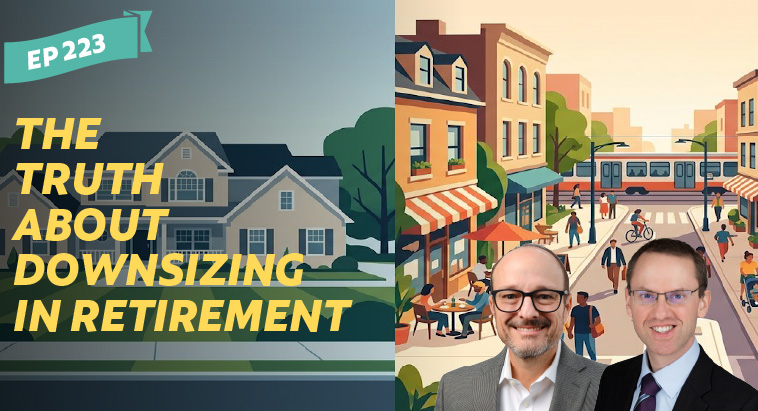
So let me pose this to you. Let's say you're doing the sort of average American thing, right? You have kids, kids are in college. By the time you're retiring, they're into their first jobs. The parents are looking around thinking, we don't need this much space in the house. The house is an asset that's illiquid. So you tell yourselves, this house is worth a million dollars. If we downsize, we can buy a similar quality house for $800,000. We can take that $200,000 and invest and use our assets more efficiently. You're saying that doesn't happen as much as you would think.
Wade Pfau 07:00
Yeah, so related to the idea of moving is also thinking about moving to downsize. Whether that's a smaller home in the same area or in an area with a lower cost of living. You might be thinking of banking on that as a way to get assets to fund other retirement expenses. And certainly there are people that do that, but that's also less common.
Wade Pfau 07:29
Mara Lynch did a study with Age Wave where they found that when people did move, only half were moving to actually smaller homes. Nineteen percent moved to the same size home and 30 percent actually moved to a larger home. When you ask people why they might even be moving to bigger homes instead of smaller homes, the main reason given was just to have space for visiting family members, including grandchildren.
Wade Pfau 07:54
So it's not obvious that people are going to downsize. It's not obvious they're going to move. And then if they do move, it's not obvious that they're going to downsize as part of that process. So the idea is just don't be too eager to think that that's going to save your retirement necessarily.
Proximity to Family & Community
Alex Murguia 09:13
I can think of some parents thinking that I may fall into this category where I don't know if younger kids in their 20s go out there and rent an apartment as opposed to maybe live with their parents for a while to save money for the down payment on their first house. It's not necessarily a failure to launch scenario, it's more of an economic sense where apartments are so expensive. Dean, the founder of McLean Asset Management, got a house in Tucson. He got an extra room in case his grandchildren visited, but his grandchildren visited maybe once a year, max. So you think you just put them up in a sofa bed at that point.
Wade Pfau 09:26
And that's not to say plenty of people do end up doing that. Just don't assume that's obviously what you're going to do because a lot of times you may have the intention and then it just doesn't work out that when push comes to shove, that's not really what you want to do.
Alex Murguia 09:43
So then the question is, if where you're at is as good as it gets, what are the characteristics of a good place to live as you're older?
Three Key Questions for Aging
Wade Pfau 09:53
Well, if you're thinking of staying in the same place or thinking to move, you want to start anticipating what might change as you age. There's a professor named Joseph Coughlin at the MIT Age Lab who identified three questions. And I think they're really good questions to help you anticipate what you need to have answers for. So thinking about as you age: who will change your light bulbs? How will you get an ice cream cone? And whom will you have lunch with?
Wade Pfau 09:53
This really speaks to the idea that with who will change your light bulbs—maybe right now you have no problem doing that. But if at some point you do have difficulty, you want to make sure you're in an area where if you needed help with things like basic home maintenance and lawn care, such help will be available, whether it's family, friends, or paid providers. With the ice cream cone question, that's really about mobility. Like right now, maybe no problem—you hop in the car, you drive to the Dairy Queen, get your ice cream cone. But if you struggle to drive in the future, will you still have that ability to get out and do those kinds of activities?
Wade Pfau 10:57
And then whom will I have lunch with is really about the social aspects. Especially as mobility tends to decline, do you have friends or other people in the general vicinity that you'll be able to continue to socialize with, even with declining mobility or situations like that? So that's a starting point.
Lifestyle & Amenity Factors
Alex Murguia 11:57
Knowing you, you would buy Nestle ice cream cones at the store and just keep them in your freezer because it's a better deal, right? You don't like to spend money if you don't need to.
Wade Pfau 12:09
I probably would do that. The Dairy Queen, that's pretty luxurious. I may not want to splurge on the banana split.
Alex Murguia 12:29
So I think, is that why you keep on asking me, hey, where are you going to retire? What zip code are you retiring in? Is that why you keep on asking me that?
Wade Pfau 13:01
Yeah, making sure you're around for lunch. That's key.
Alex Murguia 13:10
We can have a BLT, salad, whatever you want. As long as you're buying. Alright, so beyond those characteristics of a good place to live, are there any other considerations with regards to the actual home?
Affordability & Cost Considerations
Wade Pfau 13:15
Yeah, there's quite a few. Some of the things to be considering about affordability—like is this a place that will be affordable over the long term? It could be anything from whether property taxes will freeze for people once they hit age 65 to help manage property taxes, or are you in an area that's really seen a lot of appreciation in housing and your property taxes might at some point become unaffordable?
Wade Pfau 13:15
What is the overall cost of living in the area? Is there a homeowners association? What will those premiums look like over time? What are the costs of different services? If you're doing your own lawn mowing or snow shoveling now, what kind of costs would be involved if you had to outsource that to someone else? That's the sort of thing to be thinking about with respect to affordability.
Wade Pfau 15:25
Another category is proximity to family and friends. We already discussed who will you have lunch with, but are you in an area where you have access to friends and family? If you're moving, are you doing that to be close to family? What happens if your adult children subsequently move? Or what if you have trouble meeting new friends in a new area? That's a reason people tend not to move—they're really comfortable with the community where they're living right now and don't want to start over finding new friends in a new area. But that's something you do want to be thinking about over the long term.
Healthcare & Transportation Options
Alex Murguia 15:40
That's a good point. I can speak anecdotally where I mentioned Dean earlier. He was in Tucson, but both of his daughters are here in Northern Virginia. About four years ago, after being in Tucson for 10 years for half the time out of the year, they just stopped because they wanted to be near the kids. They sold the house and bought a house in Holland Hills in Northern Virginia. Same thing with my in-laws. They had a place in Santa Fe. They wanted to be around Christy, my wife, and the grandkids. They wanted to be around them, especially during their formative years. They don't even go to the Santa Fe house much, if at all—maybe twice a year for extended periods of a few weeks. But they've got a house here two or three miles away.
Wade Pfau 16:32
Was that also a case where they assumed you'd go on vacation there every year and then it ended up not necessarily?
Alex Murguia 16:37
Yeah, exactly. They did a whole renovation because the first time we visited it was kind of tight. And it wasn't cost effective. You could have bought and rented out a B&B for six months out of the year and it probably would have been the same cost.
Wade Pfau 17:05
Okay, but yeah, that's definitely something to be thinking about. Another category is agreeable climate, community, and leisure activities. Is this a nice place to live? A lot of motivation is becoming a snowbird or moving to an area with a warmer climate, which can be attractive, especially over the long term. Or maybe you are someone who likes living in an area with quite chilly winters and having the real four seasons of the year. Something for your preference is what works best for you.
Alex Murguia 17:48
Anecdotally, from our clients, what's becoming attractive are sort of metro downtown areas where everything is walkable. Whereas if you're in Northern Virginia, Arlington, the Clarendon area, where there's a little city center, there's so much walking around that you can get to everything. So the need for a car becomes less essential. Whereas if you're in a suburb, it's a little tougher. But there are certain neighborhoods where everything is walkable and that in itself becomes a destination for many of our clients when they're deciding at this age. We get many folks actually moving, but they're not moving like to a gentleman's farm or anything like that. They kind of want to move closer to the city, to the inner city almost, so everything is just accessible.
Alex Murguia 19:03
Like, I like the art, so I want to be able to do the symphony every year, and it's just one metro stop away or five blocks away or something like that.
Wade Pfau 19:01
Yeah, or college towns and auditing classes, that sort of thing. Absolutely. A place that has good activities. Golf courses, if that's something that's interesting to you, living near a golf course. Those are popping up everywhere. Pickleball courts—a must, a must. And don't complain about the noise, just deal with it.
Wade Pfau 19:26
Another issue is if you are thinking to do part-time work in retirement, of course, living in an area where the kinds of work you'd like to do are actually practical and available to you. Healthcare and long-term care is kind of an important one to think about. Just are you living in an area with good medical centers and long-term care options in the general vicinity so that if you do need access to more healthcare services at a later time, they're available within the community without too far of a commute? That's something.
Alex Murguia 20:11
You know what I think about, at my age I'm not retiring, but when we were thinking about should we get something in the Shenandoah as a second home? I'm definitely afraid of like having a heart attack or breaking my leg and being half an hour away from a hospital or something like that. It becomes a huge consideration in terms of like accidental slips and being able to have access to care immediately.
Wade Pfau 20:43
Yeah, close to a medical facility that has good quality care is absolutely important. We have to make it one of those buttons that were popular in the 1980s, the health—by falling and I can't get up.
Wade Pfau 21:02
Okay, another consideration is diverse transportation options. These days things like Uber or Lyft are making that easier. But also, are there community facilities available like vans that will help transport seniors to medical appointments or things of that nature? You may not need that now, but just thinking ahead, are there a diverse range of transportation options that can help you out if you get to a point where driving becomes more difficult?
Alex Murguia 21:32
This goes back to being more inner-city oriented, like downtown oriented, as opposed to suburban oriented housing.
Wade Pfau 21:35
Yeah. The suburbs, if you're becoming less mobile, the suburbs can become more of a trap because it's hard to get out and you're kind of isolated in the house. It can become much more difficult to have social interactions and to be part of the community. So anticipating that well in advance is kind of important when you're making that consideration about a long-term move.
Aging in Place & Home Modifications
Alex Murguia 22:14
Alright, so then what are other considerations when settling into a permanent home?
Wade Pfau 22:20
Aging in place is an important topic. You're moving into a home that you really want to be able to stay in over the long term.
Alex Murguia 22:33
When you answer that, moving into a home, I would also add that there are things you can do to your current house if you don't want to move to another home—things you can do to your house to kind of transition that.
Wade Pfau 22:41
Right, yeah. If you're not moving, you're wanting to stay in the same place, what can you be doing to ensure that it's practical that you can stay in that same place over the long term? So there's quite a few options. You could have a wheelchair accessible home by building a ramp into the home, widening doors potentially, having hallways widened so that you can easily get around the home.
Alex Murguia 23:06
Please tell me you have that little like wheelchair thing that goes up the staircases. That would be awesome.
Wade Pfau 23:01
Yeah, that would be an option. In the bathroom, walk-in showers, having grab bars available, other bathroom safety features. Or in lieu of having that, just having everything on one floor of the home so that you don't necessarily have to go upstairs. You have a kitchen, a bathing facility, a bedroom all on the same floor. You could have a built-in elevator and or the mechanical thing that carries you up the stairs that you are describing.
Wade Pfau 23:17
Other things include having door handles that are easier to use—rather than twisting knobs, having levers for your door handles. That would be a relatively cheaper thing to do. Good lighting in the home, making it easy to see. Accessible cabinets and closets and lower counters so that you could potentially do cooking in the kitchen while in a sitting position. Something to consider. Softened non-skid flooring to help cushion any falls, being careful about rugs or other things on the floor that could be tripping hazards. The tripping, that's a dangerous aspect that can lead to a lot of downward spirals ultimately.
Alex Murguia 24:56
As you get older, you can tend to shuffle your feet. It's kind of one of the precursors of even Parkinson's. So yeah, even picking your feet up by half an inch becomes not as reflexive as you think.
Smart Home Technology for Independence
Wade Pfau 25:09
And then other new technologies can help like a smartwatch or things from before, monitoring your health status, monitoring that you're taking the medicines you need. That's not necessarily something you build into the house, but it's also a consideration about independence.
Alex Murguia 25:10
Especially in the mornings. But it's something that if you can't do that, then can you stay in your house by yourself? I'll say this, and this is anecdotally because my parents went through this—they're a little past the stage now. They're both in a home. But effectively, my parents were making a mess out of their daily medication. They were making a meal of it. So it got to the point that I used Amazon prescription pill packets that separate your doses and everything for you. I have to say that worked wonders for my parents. If they didn't have that, they would have needed to have some sort of in-house care or move somewhere else simply to manage their medications.
Alex Murguia 25:49
As their executive functioning decreased, the complexities of just medication management was untenable. That does affect your ability to stay in the house because if you can't manage that, where are you, right? The other piece that worked really well for my parents—you talk about technology but not necessarily for your handheld but like those Amazon Echoes or the equivalent Google one. Where effectively you have an in-house system with smart door locks. I was really able to set up a smart home, if you will, for my mom through the Amazon Echo where I could make sure the lights are off or on, etc., there's a timer around things. If I wanted to call her, I could. If I wanted to video, I can like force the video to see what's going on in the house and make sure she's okay.
Alex Murguia 27:39
It was great. It was actually quite well and I was able to kind of notice, okay, it's time, or hey, look, how you doing, you know. It's set up for quick and dirty communications, being that I was effectively in Northern Virginia and she's in Miami. So I think technologies are there that really allow you to tether yourself with somebody else, a family member or something like that, that they can keep an eye on you without that person needing to be there 24-7.
Wade Pfau 27:39
Yeah, yeah. And that's an area that's just with technology improving all the time, it's going to get easier and easier to do that.
Carrying a Mortgage Into Retirement
Wade Pfau 27:39
OK. So then the other last topic for today, before switching over to reverse mortgages, which we're working in that direction. And it's just the whole topic of while we're talking about housing, carrying a mortgage into retirement and whether you want to do that or not. This is a trend—more and more people are getting to traditional retirement ages while still having a mortgage.
Alex Murguia 28:08
This is booming. 100%.
Wade Pfau 28:08
When we talk about sequence of returns risk in retirement and everything, if you have this fixed mortgage expense in the early retirement years and you're having to sell from your investments to pay those mortgage payments, that can create more risk for the financial plan. So do you want to carry the mortgage into retirement or would you like to pay it off before getting to retirement? Or, and we're not going to get into this today, we'll do it next week, but do you want to refinance into a reverse mortgage to take those fixed payment obligations out of the early retirement years?
Mortgage Strategy & Tax Considerations
Alex Murguia 28:48
You tell me.
Wade Pfau 28:50
Well, you have options there. Another point about all that is generally you're probably like mortgage interest can be deductible—a below the line tax deduction if you're not itemizing. But later in a mortgage, a lot more of the payment becomes paying down principal rather than interest. So the odds of actually being able to deduct interest payments does become less and less.
Wade Pfau 28:50
So there may not be any real tax benefit to having a mortgage. Sometimes people just think it's a tax benefit to have a mortgage, but that's only if you're itemizing and only for acquisition debt for the home and so forth. So you may not get any tax benefits from the mortgage. So that would speak against carrying it for that particular reason.
Alex Murguia 29:36
I would imagine the thinking is more along the lines of—I have $200,000 left on my mortgage. I have $400,000—I don't know, I have an $800,000 investment account. I could take from it and pay off the mortgage. And I have more investments. But you know what, I'd rather just pay monthly the mortgage and I'm banking on the market to kind of appreciate.
Wade Pfau 30:03
Yeah, that's a common argument. The idea that you're kind of leveraging the mortgage.
Alex Murguia 30:16
Yeah, you're borrowing money from the bank. Yeah.
Wade Pfau 30:20
Well, the mortgage, it's like a negative bond. It's a bond that you're paying the interest payments and coupons instead of someone else paying you. So if you have a negative bond, that means from the household balance sheet perspective, you have a higher stock allocation. Or just another way to think about it is, yeah, you expect that your investments are at a higher rate of return than you're paying on the mortgage. So you can arbitrage the additional gains from your investments to have more wealth overall.
Wade Pfau 30:20
And generally doing that entails risk unless you're one of these folks who got real lucky in the recent past and you may have a mortgage with lower than 3% interest rate. Then it's pretty easy today to just have very low risk investments that would exceed the mortgage rate. But more generally, you often have to take risk to have your investments outperform the interest you're paying on a mortgage. And do you want to take that risk? Or it may just be maybe you could reasonably expect keeping the mortgage would pay off, but it becomes more of a psychological thing where you just, you'd sleep better at night, you'd feel more comfortable not having the mortgage. And then it can make sense to pay it down just to have that much less stress for your retirement.
Alex Murguia 31:34
What are you planning on doing?
Wade Pfau 31:36
I actually, most of the time I do things pretty rationally about investing and so forth, but I actually didn't want to have a mortgage. Even though in hindsight, I would have been better off leveraging it for the investments. I don't want to deal with it. Not having the hassle, peace of mind, not having to deal with the refinancing process.
Alex Murguia 31:50
Look at you! Wow! Why did you do it? Just a piece of mind for you? That's fine, totally valid answer.
Wade Pfau 32:16
So when we moved to Texas, I remembered the hassle involved in getting a mortgage when we had moved to Pennsylvania before that. And just, I don't want to deal with it.
Alex Murguia 32:21
Really? You probably did well in terms of property, selling the property from Philadelphia going to Dallas. You probably got some appreciation there?
Wade Pfau 32:21
Well, that's not true. There was no appreciation on that. For the six years I was in Pennsylvania, we had a slight decrease in the home value. It shot up after I moved, but no, I didn't benefit from housing appreciation.
Alex Murguia 32:45
So you're just doing it, you're only going to get the tax benefit from the deduction enough to warrant doing that. I just like the hell with it.
Wade Pfau 32:52
Pretty much.
Alex Murguia 32:53
Fair enough. That's fine. Sounds like you'd have a mortgage. Sounds like you still have a mortgage based on your investment strategy.
Wade Pfau 32:56
That's right. I'm mostly in stocks, but I'm not going to leverage it by having a negative bond also. So I paid off the mortgage and now I can justify being mostly in stocks. I guess it's another way you could think about it.
Alex Murguia 33:29
Comment below. Follow you, comment below, please. I'll put your thoughts on Wade's decisions. We want to know.
Wade Pfau 33:49
Yeah, that's pretty much what we have for the first half of chapter nine of the retirement planning guidebook. And then there's still more content we'll do in the next week's episode. We'll talk about reverse mortgages, which is the other important aspect. If you do have an eligible home, do you want to consider that as part of the financial plan?
Alex Murguia 33:49
Alright everyone, thank you and we'll catch you next week on Retire with Style.
This podcast is designed for informational purposes only. It is not intended to provide specific investment advice or recommendations for any individual. The opinions expressed are those of the speakers and are subject to change without notice. Past performance does not guarantee future results. Please consult with a financial advisor before making any investment decisions.